Electric Fireplace vs Wood Burning Fireplace
Pick an electric fireplace if you want the look without smoke, ash or a chimney. A wood burning fireplace suits you if real flame is the point and you can keep up the chimney and the wood.
On this page (14 sections)
- Heat: a heater you set, or a fire that changes
- Mess, ash and smoke: what each one leaves behind
- Starting up and control
- Chimney upkeep and venting
- Install: a firebox, a trim kit or a recessed wall
- How heavy are the two electric examples?
- Upkeep and warranty: what comes with each
- Realism: the flame, the log and the sound
- What a real fire gives you that electric doesn't
- Power use and running costs
- Glass front and trim: what the electric units add
- Can you hang a TV above an electric fireplace?
- What should you ask before you choose?
- Which to pick: electric fireplace or wood burning fireplace
A wood burning fireplace gives you a real fire, with real smoke, ash and a chimney to keep clean. An electric fireplace gives you a flame effect and a heater, with no fuel to burn and no chimney to clear.
This guide compares the two side by side. It uses two electric examples, the PuraFlame Klaus for an old firebox and the Touchstone Sideline 60 for a new recessed wall, so you can see how each one fits a room.
 Best for a new wall built for a recessed unit
Touchstone Sideline 60 in Recessed
 Best for an old firebox that needs a trim kit and glass door
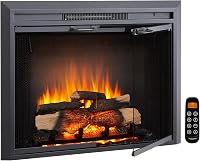
PuraFlame Klaus Insert with Trim Kit
Our score weighs specs, features and buyer feedback against what you're shopping for.
| Product | Best for | Width | Depth | Power | Our score |
|---|---|---|---|---|---|
| Touchstone Sideline 60 in Recessed | a new wall built for a recessed unit | 60 in | 5.5 in | Plug in or hard-wire | 8.5 |
| PuraFlame Klaus Insert with Trim Kit | an old firebox that needs a trim kit and glass door | 44.1 in overall | 10 in | Plug in, 120 V, not hard-wired | 8.2 |
Heat: a heater you set, or a fire that changes
An electric fireplace gives heat from a 750 W or 1,500 W heater that you set, while a wood burning fire gives heat that changes with the wood, the firebox and the draft. Neither one is a whole-house heater for most homes.
The Klaus is rated for supplemental heat up to 400 sq ft, and PuraFlame says it's not a main heat source.
The Sideline 60 has a 1,500 W heater, and Touchstone says it takes the edge off a cool room but won't replace a primary heat source.
A wood fire's heat changes from hour to hour. That's harder to predict than a unit with a set power level.
PuraFlame puts the Klaus at about 4,600 BTU per hour, and Touchstone puts the Sideline 60 at 5,000 BTU per hour. Both are the makers' own figures.
On the high setting, an electric unit uses 1.5 kilowatt-hours for each hour it runs. For how that power turns into heat in your home, read are electric fireplaces energy efficient.
Mess, ash and smoke: what each one leaves behind
A wood fire leaves ash, soot and smoke to clean up, while an electric fireplace leaves dust on the glass and remote batteries to replace. A wood fire also puts smoke and odor into the room, which an electric unit doesn't.
PuraFlame says the Klaus has no dust or ashes to clean, since the resin log sits on an ember bed rather than wood. Touchstone describes the Sideline as smokeless, with no venting or chimney needed.
A wood fire needs wood stored and dry, the ash removed and the firebox cleaned between fires. It sends smoke up the chimney, and some can drift back into the room when the draft changes.
Starting up and control
An electric unit starts with a remote, while a wood fire takes time to build, light and burn down. The difference matters on a weeknight when you just want to sit down and turn the flame on.
A wood fire needs kindling, wood and time, and the ash has to cool before you can clean it. None of that is needed to switch on an electric unit.
Touchstone says the Sideline has a built-in heat timer that shuts off in 1 to 8 hours, and it runs from a remote, an app or a timer. It also works with Alexa or Google Home, Touchstone says.
The Klaus runs from a remote with an adjustable thermostat and three flame settings, and it works with or without heat.
Chimney upkeep and venting
A wood fire needs a chimney that draws smoke out and gets cleaned on a regular schedule. The electric units here need no chimney, flue or gas line, since they burn no fuel.
Before the Klaus goes into an old firebox, ask a chimney pro what to do with your flue and damper. Touchstone says to have a licensed professional check that any unused gas lines and vents are secured.
The National Fire Protection Association's home fire safety pages are a place to start for heating and fireplace safety.
A yearly look from a chimney pro is a sensible habit with a wood fire. For the venting answer for electric inserts in more detail, read do electric fireplace inserts need to be vented.
Install: a firebox, a trim kit or a recessed wall
A wood fireplace is built into the house, while the electric units here either fit an existing firebox or sit in a framed wall. That difference shapes the whole project.
The Klaus has a trim kit and a glass door, so it fits an existing firebox and gives it a finished front.
The Sideline 60 is built for a recessed wall and can be attached to framing studs, and it includes a wall-mount bracket if you don't recess it.
The Klaus is 44.1 in wide and 10 in deep, even though its name says 33, and the Sideline 60 is 60 in wide and 5.5 in deep. Ask PuraFlame which width matches your firebox, since those numbers decide which opening each one suits.
Framing, drywall cuts and trim belong to the manual and a pro. Never cut into a load-bearing wall, or a wall that has wires or pipes in it.
If you're replacing an open firebox, read putting an electric insert in an existing fireplace for the steps and the trade-offs.
How heavy are the two electric examples?
The Sideline 60 weighs 62 lb, so plan on a helper. Touchstone includes drywall anchors, screws and a wall-mount bracket with it.
PuraFlame gives no weight for the Klaus, so ask before you plan a one-person carry. A wood fireplace is built into the house, so there's no unit to lift.
Upkeep and warranty: what comes with each
Both electric units carry a one-year limited warranty from the maker, PuraFlame for the Klaus and Touchstone for the Sideline. Upkeep is dusting the glass and replacing the AAA batteries in the remote.
A wood fireplace asks for a chimney check and a clean hearth instead. Keep the manual for either kind, since each has its own care needs.
Realism: the flame, the log and the sound
A wood fire has real flame and real smoke, and the flame moves with the wood. The electric units use an LED flame and a resin or faux log, which looks like wood without the wood.
The Klaus has a resin log 11 13/16 in high on a grate above an ember bed, a three-sided brick interior and a fire crackling sound. The Sideline has five flame settings and 30 ember and flame color options, with a log or crystal hearth.
A wood fire moves and crackles on its own, so if real fire is the point, a wood fire is the choice.
What a real fire gives you that electric doesn't
A real fire gives you moving flame, real smoke and the smell of burning wood, and an electric unit can only imitate those. That's the honest trade-off, and it's the main reason to keep a wood fire.
The electric units here look good, but they aren't a real fire. Touchstone calls its flame realistic, and PuraFlame says its log looks like a wood burning fireplace, and both are maker claims.
If the fire itself is the point, that difference matters more than any spec on this page. The chimney and the wood are part of the cost of keeping it.
Power use and running costs
Both electric units top out at 1,500 W on the high setting, which is about 5,100 BTU per hour. The Klaus plugs into a 120 V outlet and can't be hard-wired.
Touchstone says the Sideline 60 draws a maximum of 12 amps, so it can run on a 15-amp circuit, and a 20-amp circuit may be needed if other devices share it. It can also be hard-wired, which is a job for a licensed electrician.
Multiply 1.5 kilowatt-hours by your hours of use and your electric rate, which is on your bill, to see what the high setting costs in your home. The 750 W setting uses half that.
Electric fireplace power vs a wood burning fire
A wood fire's cost depends on the wood you buy, how long it burns and how much heat escapes up the chimney. Compare your own wood and electric bills, since the two costs don't work the same way.
Glass front and trim: what the electric units add
The Klaus adds a trim kit, a glass door and a mesh screen, and the Sideline adds a recessed frame with a log or crystal hearth. Both give a finished front that an open firebox doesn't have.
Follow each maker's manual for the clearances that apply to the unit. A wood fire has an open front or a screen, which changes how the room looks, so decide on the front style first.
Can you hang a TV above an electric fireplace?
Read the fireplace maker's notes and the TV maker's heat notes before you hang a TV above any fireplace. Don't assume a TV is safe above a heater just because the unit fits the wall.
Touchstone recommends at least 8 in between the top of the Sideline and a TV, mantel or picture. That's one maker's number, not an all-clear, and PuraFlame gives no clearance number for the Klaus, so check its manual.
A wood fireplace has its own mantel and TV clearance rules, so check those notes too.
What should you ask before you choose?
Ask whether the fireplace is a firebox you can fill with an insert, whether an outlet can reach the spot, and whether you want real smoke and wood at all. Those three answers decide most of the choice.
If the firebox is old, an insert such as the Klaus is one electric route. If the wall is new, a recessed unit such as the Sideline 60 is the other, and the framing belongs to the manual and a pro.
If no outlet reaches the spot, a licensed electrician has to add one before an electric unit works there. Gas is the other route, and it needs its own line and vent from a licensed pro.
Which to pick: electric fireplace or wood burning fireplace
Pick an electric fireplace if you want the look without smoke, ash or a chimney, plus a supplemental heater for one room. Pick a wood burning fireplace if real flame and smoke are the point, and you can keep up the chimney and the wood.
Pick the Klaus if you're keeping an old firebox and want a glass door and trim. Pick the Sideline 60 if you're building a new recessed wall and want a flame in a slim frame.
Each has its own care needs, so follow the manual either way. If you're weighing gas too, read gas fireplace vs electric fireplace next, or see best electric fireplace inserts and the wall mounted and recessed guide.
Frequently asked questions
Is an electric fireplace safer than a wood burning fireplace?
Neither is automatically safer, since each one has its own care needs. The electric unit has no fire to tend, but it still needs clear air grilles and the maker's clearances, while a wood fire needs a clean chimney and a screen.
Does an electric fireplace need a chimney?
No, an electric fireplace burns no fuel, so it needs no chimney, flue or gas line. Ask a chimney pro what to do with the flue and damper, and have an old chimney checked before you install.
Can an electric fireplace replace a wood burning fireplace?
It can sit in an existing firebox if the opening and the outlet both work. The Klaus has a trim kit and glass door for an old firebox, but it gives supplemental heat only, so it won't replace your main heating.
How much does an electric fireplace cost to run?
It depends on your electric rate and how many hours you run it, since a 1,500 W setting uses 1.5 kilowatt-hours each hour on high and the 750 W setting uses half that. Multiply by your own hours and rate on your bill to see the number for your home.