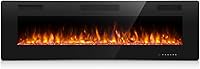
Electric Fireplace Buying Guide for the Living Room
An electric fireplace for the living room starts with the type: wall mounted, recessed, insert or TV stand. Then decide the width, depth, heat, controls and budget tier, in that order.
On this page (12 sections)
- Pick the electric fireplace type for your living room
- Choose the width from your wall and TV, not the box
- Check depth, stud fit and the power plan before you fall for a unit
- Weigh the unit before you pick the bracket and wall
- Decide how much heat you need from a zone heater
- Pick controls, sound and a flame look you'll use
- Judge the look from the glass, the bed and the colors
- Set a budget tier before you compare picks
- Plan the room around the unit before it arrives
- Pick a finish that fits the room
- What should you check before you order an electric fireplace?
- Which living room setup should you pick?
For a living room, pick the type of electric fireplace first, then the width, depth, heat and controls. The right unit depends on your wall, your TV, and whether you want a flame look, some extra heat or both.
Work through the decisions below in order. Each one links to a deeper guide, and the wall mounted and recessed electric fireplaces guide covers install basics and safety in one place.
Pick the electric fireplace type for your living room
A wall mounted unit hangs on the surface, a recessed unit sits in a framed opening, an insert fits a firebox or cabinet, and a TV stand holds the fireplace in a freestanding piece. Pick the type first, since it sets the install work.
A wall mounted unit is the simplest route if your wall is finished and you want the flame on the surface. It needs a secure bracket into studs or anchors, and that is the main job.
A recessed unit looks close to flush with the wall, but it needs a framed opening, a cutout and a plan for the cord. Give it more time, and bring in a pro if the wall isn't simple.
An insert suits a fireplace opening or cabinet you already have, and many inserts come with a trim kit. A log set sits in an existing hearth with no trim kit, so it's the choice if you'd rather skip that work.
The insert vs log set comparison covers that choice in more detail.
A TV stand fits a living room where no wall can take a unit. The PRAISUN stand below is 70.9 in wide, 13.8 in deep and 32.2 in tall, with a 48 in fireplace, and PRAISUN says it fits TVs up to 80 in.
Choose the width from your wall and TV, not the box
Start with the width of the wall, then choose 36 in for a small wall, 50 in for most living rooms and 60 in for a wide wall. Use the TV and the furniture to check the balance, not just the number on the box.
Matching an electric fireplace for the living room to your wall
Measure the wall at the top, middle and bottom, and plan around the narrowest reading. A wall that reads differently at each point is the one to measure twice.
If you're between two sizes, pick the one that leaves a clear gap on each side of the TV or the furniture, not the one that runs edge to edge.
The what size guide covers the measuring steps, and the best wall mounted electric fireplaces roundup compares units by width.
Check depth, stud fit and the power plan before you fall for a unit
Depth decides how far the unit sticks out, and stud fit decides whether a recessed unit can go into your wall at all. Power decides where the unit can go, so settle plug-in or hard-wired early.
The slim wall units in this guide run from 3.86 in to 5.5 in deep, while the PuraFlame Western insert is 8.78 in deep. Compare each unit's depth with the space your wall or opening offers.
The PuraFlame Western is about 35 in wide and 27 in tall overall, with a firebox about 32 in wide and 25.5 in tall. Measure your opening against both sets of numbers.
R.W.FLAME says its 60 in unit fits a 2 x 6 stud, so check the stud size before you plan a recessed install.
A recessed unit needs framing, a cutout and a check for wires and pipes before any cut. If you're unsure what's inside the wall or what it carries, ask a pro, and leave the framing details to the manual.
The wall mounted vs recessed comparison and the recessed install guide walk through those framing questions.
A plug-in unit needs a working outlet within reach of the cord. A hard-wired unit needs a licensed electrician if the manual calls for one, and Touchstone's Sideline can be hard-wired or plugged in.
PuraFlame's Western insert plugs into a 120 V outlet and can't be hard-wired, so plan the outlet spot before you buy.
Westinghouse says not to share its 120 V, 15 A circuit with other appliances.
Weigh the unit before you pick the bracket and wall
Weight decides how solid the bracket and the wall must be, and whether one person can hang the unit alone. Heavier units need the anchors or studs the maker lists, not whatever is handy.
Antarctic Star's 36 in unit weighs 33 lb, and the EUHOMY 50 in weighs 22.7 lb. The R.W.FLAME 60 in weighs 47.7 lb, and the Touchstone 50 in weighs 59 lb.
The Touchstone comes with drywall anchors and screws, and Westinghouse includes wall anchors and a wall bracket. PRAISUN's TV stand weighs 80.3 lb before you add a TV, so plan on a helper for setup.
Decide how much heat you need from a zone heater
Most units in this guide offer 750 W and 1,500 W settings, and the high setting is about 5,100 BTU per hour. That's zone heat for one room, not a whole-house system.
Watts measure how much electricity the heater draws, and BTU per hour measures heat output. A 750 W setting is about 2,560 BTU per hour, and a 1,500 W setting is about 5,100.
Decide whether you want the heat or just the flame. Flame-only mode gives you the look without running the heater, and Antarctic Star, EUHOMY and Touchstone each offer that option.
Antarctic Star's 36 in unit also has a front heater blower, which pushes the warm air out into the room.
Makers often quote up to 400 sq ft for their heat. Treat that as the maker's claim for a room, not a promise for yours.
At full heat, a 1,500 W unit uses 1.5 kWh for each hour it runs. Multiply that by your electric rate to estimate what an hour of heat costs you.
The Department of Energy's Energy Saver site covers heating and power use in general terms.
Read do electric fireplaces give off heat? for the full picture on heat output, and are electric fireplaces worth it? for the trade-offs.
Pick controls, sound and a flame look you'll use
Most units here come with a remote and a timer, and some add a touch panel or smart control. Touchstone's wireless remote runs the flame color, flame intensity, heater and shut-off timer.
Westinghouse works with Alexa and Google Home, and it offers up to 144 flame and ember color combinations. A plain remote is enough if you don't need a phone or voice control.
Antarctic Star pairs a remote with a touch screen and adds a sleep mode. PRAISUN's stand has a 64°F to 82°F thermostat, 8 flame colors and a heat-lock feature.
Timers matter too. Antarctic Star, EUHOMY and Touchstone each offer a 1 to 8 hour timer, so the heat can run for only the part of the evening you need it.
Sound is the other choice. EUHOMY says its unit runs at about 45 decibels, R.W.FLAME calls its unit low noise, and PuraFlame's Western insert adds a crackling sound.
Judge the look from the glass, the bed and the colors
Judge the look by the glass, the bed and the color modes. Those three parts shape it more than the frame does.
Frames and glass differ from maker to maker. R.W.FLAME uses alloy steel, EUHOMY uses a black tempered glass front, and Westinghouse pairs metal with tempered glass.
PuraFlame describes its Western insert as having a three-sided interior brick wall and a clean glass front trim. Westinghouse includes interchangeable faux log and crystal ember bed sets, and Touchstone includes faux-fire logs and crystals.
Color modes are the other lever. R.W.FLAME offers 12 flame and LED bed colors with 5 flame speeds, and EUHOMY offers 12 flame colors and 12 LED fuel bed colors.
Set a budget tier before you compare picks
This guide sorts its units into budget, mid-range and premium tiers by how they compare on price. Heat settings are close across the wall units, so look at size, controls and finish before you pay more.
- Budget: Antarctic Star 36 in, with a remote, a timer and a front heater blower.
- Mid-range: EUHOMY 50 in, R.W.FLAME 60 in and PuraFlame's Western insert.
- Premium: Touchstone 50 in, Westinghouse 50 in and the PRAISUN TV stand.
The tier doesn't change the heat much, so pay for the features you'll use, like a remote, a timer or a smart control.
Prices move, so a unit can shift tiers over time. If you're comparing inserts, the best electric fireplace inserts roundup compares them by width, trim and features.
Plan the room around the unit before it arrives
Plan the outlet, the cord route, the TV and the seating before the unit arrives. Those four things decide where the unit can go.
Sit where you usually sit and note where your eyes land. Put the flame in that line of sight, not in a corner nobody looks at.
Think about seating height too, since a unit mounted low can sit below eye level when you're on the sofa. Compare the sofa and TV heights with where the unit will sit.
Check where the outlet is, and whether a cord will cross a walkway. A cord across a walkway is a trip hazard, so plan the cord route or pick another spot.
If a TV will share the wall, read both makers' heat and clearance notes before you choose the spot. As one example, Touchstone says to allow at least 8 in of space above its Sideline, and that figure belongs to that unit alone.
The plan a TV wall guide walks through the order to plan the wall.
Pick a finish that fits the room
Most units here are black, and the PRAISUN stand is the one white piece, with a distressed finish.
Finish names differ by maker. R.W.FLAME and EUHOMY use a polished finish, Antarctic Star uses a painted one, and Westinghouse uses a lacquered one.
Match the finish to your TV frame and the trim around the wall, so the fireplace reads as part of the room.
What should you check before you order an electric fireplace?
Check the wall, the depth, the power, the clearances, the TV and the maker's room-size claim, so the unit fits the room you have.
- Wall width and height at three points
- Depth from the wall face, and the stud size for a recessed unit
- Outlet location, whether the unit plugs in or is hard-wired, and cord reach
- Height of any ceiling, mantel or shelf above the unit
- TV width, and the heat and clearance notes from both makers
- The maker's room-size claim, and how it compares with your room
Which living room setup should you pick?
For a living room, pick a wall mounted electric fireplace if your wall is finished and you want the simplest install. Pick a recessed electric fireplace if you can frame the opening and want the unit to sit close to flush with the wall.
Pick an insert if you already have a firebox or cabinet opening, and a log set if that fireplace is there and you want no trim kit. Pick a TV stand if no wall can take a unit.
For the install and safety details behind those choices, read the wall mounted and recessed electric fireplaces guide.
Frequently asked questions
Is an electric fireplace a good choice for a living room?
It can be, if you want a flame look and some extra warmth in one room. It isn't a main heat source, so pick a type and width that fit your wall, and expect 750 W and 1,500 W settings on most units here.
Which electric fireplace type is easiest to install?
A wall mounted unit is usually the simplest, because it hangs on a bracket and needs no cutout. A recessed unit needs framing, and an insert needs a fit check against its firebox or cabinet opening, so plan the time and the power before you order.
Do I need an electrician for an electric fireplace?
Sometimes, since a plug-in unit may not need one, but the manual decides. If it calls for a hard-wired unit, a new outlet or a new circuit, use a licensed electrician instead of running new wiring yourself, and check whether the unit plugs in or is hard-wired before you pick the wall.